“Remember the days of old, consider the years of all generations. Ask your father, and he will inform you, your elders, and they will tell you.” — Book of Deuteronomy 32:7
Who we are has become a central pursuit of our lives.
We want to clearly identify our skills, refine them, and find ways for them to sustain us. We want what we produce to matter. None of this is new to us—it is the air we breathe. But in the long timeline of humanity, this way of thinking is revolutionary.
For millennia, life was not built on self-discovery but on reception.
There was a process—a passing and a giving. Each generation received what had been handed down, became indebted to it, worked it, honed it, and then passed it on again. Identity was not something you created from within; it was something you entered into, something you carried forward.
Most of life was local. The boundaries were small—often no more than ten miles, rarely more than thirty in a lifetime. And yet, within those boundaries, something profound was happening: continuity. Memory. Belonging.
There were, of course, those who went beyond.
One of the most striking examples is Egeria, an unknown woman who journeyed from Spain to the Holy Land on foot. Her letters, sent back to her community, still survive. They give us a glimpse into not only what she saw, but why she went.
Travel, in her world, was never casual.
To move beyond the familiar was costly—physically, financially, even spiritually. People did not travel simply to see sights or accumulate experiences. There were only a few reasons to go: commerce, war, or pilgrimage.
Commerce required risk. War often forced movement. But pilgrimage—that was chosen.
Men and women would leave everything behind out of a deep desire to seek God. This was not unique to Christianity, but within the Christian tradition it took on a distinct clarity: to go was to seek, to repent, to draw near.
Something has shifted.
Over the past five hundred years—from the age of exploration through the industrial revolution and into our present moment—the world has opened up in ways that have brought undeniable good. But alongside that good, something has been lost.
We are more mobile than ever, yet more disconnected.
More expressive, yet more uncertain.
More capable, yet more alone.
We are trying, with increasing urgency, to answer the question: Who am I?
I am not outside of this. I am a product of it.
And yet, I find myself wanting something different. Not a rejection of everything new—but a recovery of something old.
I want to be connected to the generations again.
I want travel to have purpose again.
I want my life to be measured not simply by what I accomplish, but by what I receive—and what I am able to give.
Recently, I found myself in a conversation about generational identity. The labels came out easily—Gen X, Millennials, and then even more refined distinctions. One of my coworkers mentioned he belonged to a micro-generation called “Xennials.” Curious, I looked it up later.
And there it was—another label, another subdivision.
Oddly, I discovered I fit there too.
But what I felt wasn’t relief at being more precisely defined. It was something else—something closer to resistance. And as I sat with it, I realized what was underneath.
It wasn’t that I didn’t want to be labeled.
It was that I didn’t want to be separated.
Separated by age.
Separated by assumptions.
Separated into categories that talk about one another more than they listen to one another.
In that moment, something clarified.
What I am longing for is not a new idea. It is not a revolution. It is something much quieter, much older.
It is a return.
A return to tradition—not as rigidity, but as a living stream.
A return to proximity—where wisdom is not broadcast, but embodied and received.
A return to posture—where we choose to lower ourselves, to listen, to sit at the feet of those who have gone before us.
Because when I look out, I see something I cannot ignore:
I see elders who are ready to give, but have no one to receive.
I see lives filled with hard-won wisdom, with no place to land.
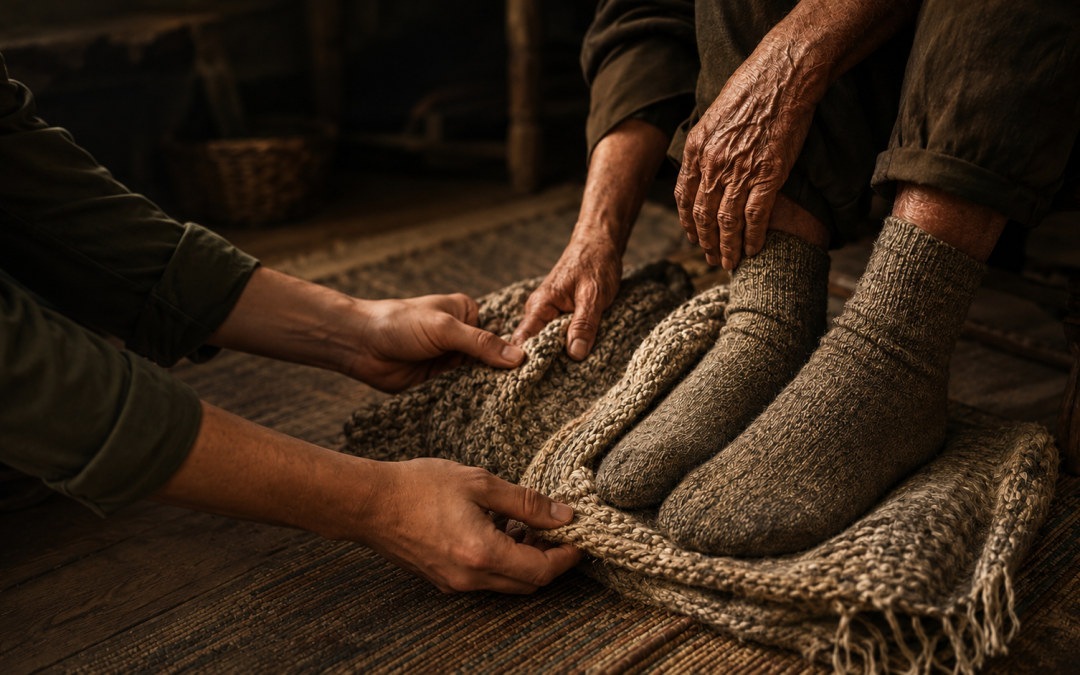
I see a generation whose feet are cold.
So I am trying.
I am placing myself, intentionally, at the feet of those who have lived more than I have.
I am beginning to see my movement—my travel—not as consumption, but as pilgrimage.
I am resisting the urge to build something entirely new, and instead asking what it means to be faithful with what has already been given.
This blog is an expression of that pursuit.
Not an attempt to change the world, but an attempt to recover something we have lost. To reconnect what has been severed. To warm what has grown cold.
I want to share reflections, practices, and challenges—for myself, and for anyone who senses the same longing.
I’ll close this first post with a poem I wrote while wrestling with the weight of this. At first, it felt overwhelming—like trying to solve a modern problem. But the more I considered the way of the ancients, the more it simplified.
Perhaps the task is not to fix everything.
Perhaps it is simply to be faithful—
to receive,
to tend,
and to pass on.
The Elders’ Feet Are Cold
Remember the generations of old,
Consider the years of all generations.
Ask your father—he will inform you,
Your elders—they will tell you.
But we have lost the line
That binds us to the story of all time.
The elders’ feet are cold.
Their years sit heavy with fruit,
Unharvested,
Unreceived—
Because none have come to listen.
And still, we wait
For a fresh voice to rise.
The youth shouts,
“Look out!”
And with it comes the stampede—
Energy without memory,
Movement without root.
And the elders’ feet—
are cold.
We name each other,
Sort each other,
Explain each other away.
In crowded rooms
We speak at one another
Across decades—
Highlighting strengths,
Exposing weakness—
But never truly learning,
Because we never truly listen.
And the elders’ feet—
are cold.
It is not a revolution we need.
Not another new idea.
It is a bending.
A lowering.
A choice.
To seek wisdom.
To listen.
To be formed.
To cover the feet,
To warm the hearts,
To reconnect the lives.
To resist the endless pursuit of novelty,
And instead—
embrace community.
Then, perhaps,
The elders’ feet
Will no longer be cold.